Tan Lih Woei, is a Director of Lih Ming Pte Ltd (formerly known as Lih Ming Construction Pte Ltd), one of Singapore’s more established underground utilities and civil engineering companies. With more than two decades of leadership experience, he has played a pivotal role in transforming a traditional construction business into a forward-looking enterprise recognised for its commitment to innovation, workforce development, operational excellence and sustainable business practices. Under his leadership, Lih Ming has continually embraced digitalisation, process innovation and human capital development to strengthen productivity while creating meaningful career opportunities within the built environment sector.
Growing up in a family of contractors, Tan developed an early appreciation for infrastructure development and the impact that quality construction has on the nation’s growth. He co-founded Lih Ming Construction together with his brother in 2002. With experiences across several industries, they started building the company in full swing in 2005, from modest beginnings into a respected specialist contractor serving Singapore’s underground utilities and infrastructure sectors. Throughout this journey, he has remained guided by the belief that long-term success is built upon integrity, continuous learning, and investing in people as much as technology.
As a Director, Tan oversees the strategic direction, organisational development and business transformation of Lih Ming. The company specialises in engineering procurement and construction management, underground gas/cables/utilities pipeline systems, civil engineering works, utility infrastructure, road reinstatement and related engineering services, supporting critical national infrastructure projects across Singapore.
Over the years, he has championed the company’s evolution from a conventional construction contractor into a technology-enabled organisation with a strong emphasis on workforce capability, operational excellence and continuous improvement. He believes that transformation extends beyond adopting new technologies – it requires redesigning work, developing new competencies and creating an organisational culture that empowers employees to contribute ideas and embrace change.
His leadership philosophy is firmly centred on balancing business performance with people development. He has consistently invested in employee training, leadership development, workplace safety, digital systems and organisational capability, recognising that sustainable competitive advantage comes from a skilled, engaged and adaptable workforce rather than from technology alone. This people-first philosophy has contributed to strong employee engagement, capability building and a culture of continuous learning and improvement throughout the organisation.
Tan holds a Bachelor of Applied Science specialising in Construction Management from RMIT University, where he built a strong foundation in project management, construction methodologies and organisational leadership.
Recognising that effective leadership requires lifelong learning, he further completed a Graduate Certificate in Real Estate Finance from the National University of Singapore. His continued pursuit of professional development reflects his belief that business leaders must continually broaden their perspectives to navigate an increasingly complex and rapidly changing environment.
Throughout his career, Tan has actively sought opportunities to deepen his knowledge in sustainability, business transformation, digitalisation, leadership and organisational development, enabling him to guide Lih Ming’s ongoing transformation while contributing to the wider construction industry’s evolution.
Tan’s professional interests span the intersection of business strategy, workforce transformation and technological innovation within the built environment sector. His key areas of expertise include:
– Workforce transformation and job redesign
– Human capital development and leadership capability building
– Organisational change management
– Construction productivity improvement
– Digital transformation and enterprise systems implementation
– Process redesign and operational excellence
– Workplace safety and performance management
– Sustainable business practices and ESG integration
– Innovation in construction technologies
– Talent attraction and retention within the built environment sector
He is particularly passionate about changing perceptions of the construction industry by demonstrating that construction careers can be technology-driven, highly skilled and professionally rewarding. He believes that attracting younger generations into the sector requires organisations to redesign jobs, modernise work processes and provide meaningful opportunities for continuous learning and career progression.
One of Tan’s most significant contributions has been his leadership in workforce transformation through structured job redesign initiatives.
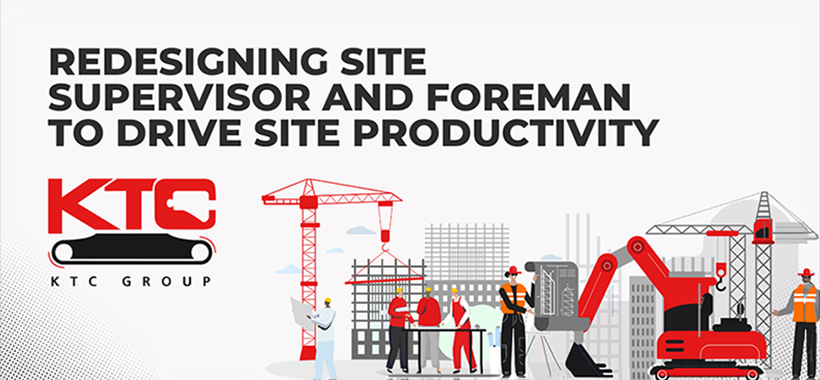
Recognising the operational challenges faced by construction supervisor’s including inconsistent productivity, increasing overtime and varying levels of project management capability—he led the redesign of the Site Supervisor role within Lih Ming. Rather than focusing solely on technology adoption, the initiative fundamentally redefined the competencies, responsibilities and support systems required for the role.
The redesigned position incorporated four critical competency domains:
- Enterprise systems utilisation for resource planning
- Advanced project management capabilities
- Leadership and people management
- Communication and stakeholder engagement
To ensure successful implementation, Tan championed an individualised capability development approach, providing supervisors with targeted training based on their respective learning needs. Clear performance indicators and standardised productivity benchmarks were established, enabling supervisors to better plan manpower deployment, monitor work progress and improve team performance.
The initiative delivered measurable operational improvements. Through redesigned work processes and enhanced workforce capabilities, Lih Ming successfully standardised productivity expectations, enabling a six-person team to lay 24×36 metres of larger-diameter pipelines daily while reducing overtime requirements. Beyond productivity gains, the programme strengthened employee confidence, improved leadership capability among frontline supervisors and reinforced a culture of continuous learning.
Beyond formal job redesign, Tan has continuously driven organisational transformation through digitalisation. Under his leadership, Lih Ming progressively evolved from manual processes to integrated digital systems for project planning, operational management and business administration. He has consistently viewed technology not as a replacement for people, but as an enabler that allows employees to perform higher-value work while improving collaboration, decision-making and customer outcomes.
He has also been a strong advocate for embedding learning into daily work. Through structured competency development, leadership training and performance management initiatives, he has fostered an organisational culture where employees are encouraged to innovate, challenge existing practices and continuously improve the way work is performed.
Tan believes that Singapore’s construction sector is entering a new era where competitiveness will increasingly depend on workforce capabilities rather than labour intensity. As technologies such as artificial intelligence, automation, digital twins and data analytics become more prevalent, organisations must redesign jobs to equip employees with new competencies while preserving the human skills of leadership, communication and problem-solving.
He hopes to contribute practical industry perspectives on workforce transformation within the construction sector while learning from fellow practitioners across different industries. He believes that effective job redesign requires close collaboration between business leaders, HR professionals, operational teams and employees, ensuring that transformation initiatives deliver value for both organisations and the workforce.
Guided by his belief that organisations grow when their people grow, Tan continues to champion workplace innovation, capability development and sustainable business transformation. His aspiration is not only to build stronger organisations, but also to help shape a more resilient, future-ready workforce capable of supporting Singapore’s continued economic and infrastructure development.