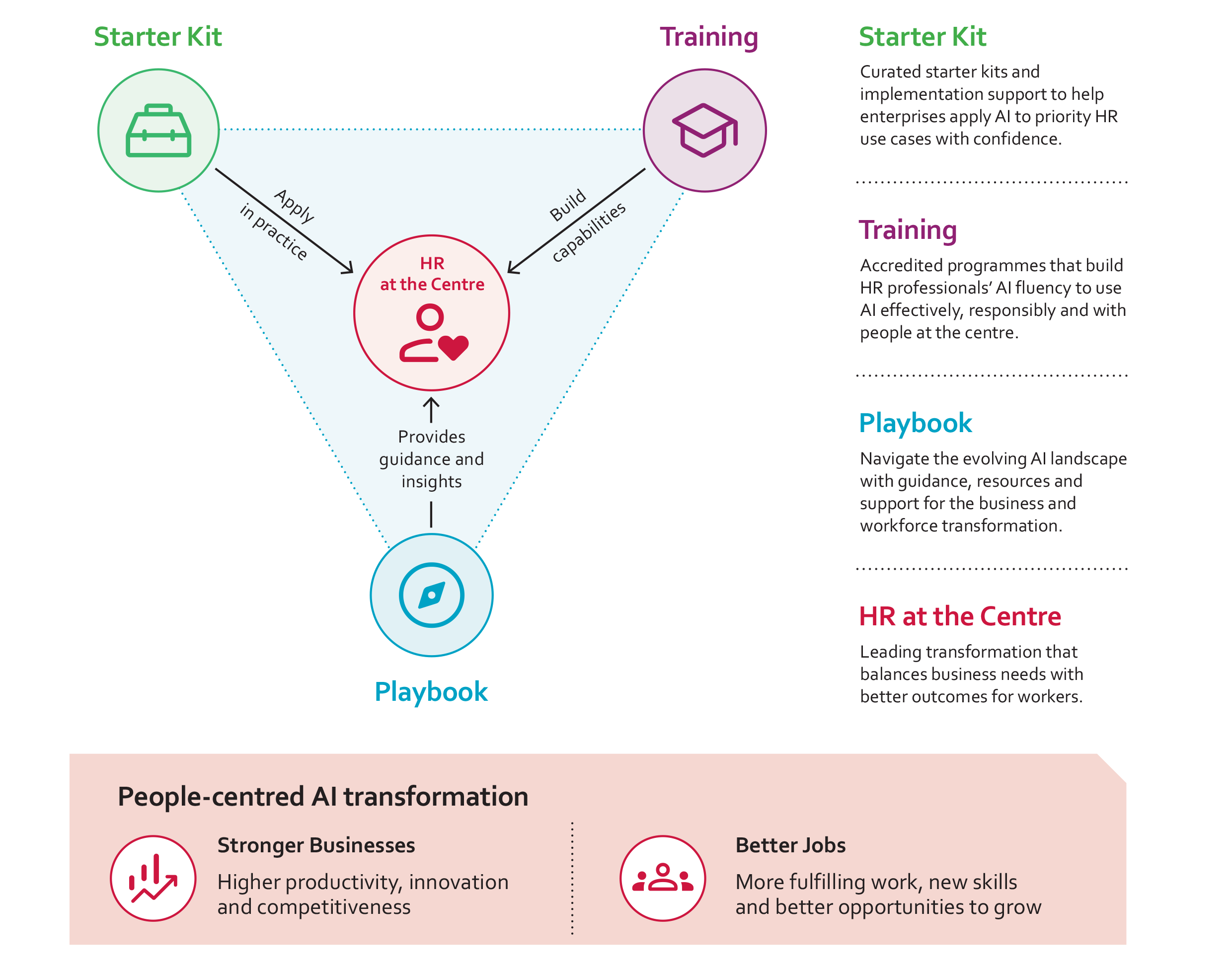
As part of the Tripartite Workgroup on Human Capital Capability Development (TWG-HC)’s recommendations to strengthen human capital in Singapore, the People-centred AI Transformation for HR (PATH) initiative will help businesses put people at the centre of AI transformation.
Overview
Find your PATH
Helping Businesses Use AI to Transform Work, with People at the Centre
As part of the Tripartite Workgroup on Human Capital Capability Development (TWG-HC)’s recommendations to strengthen human capital in Singapore, the People-centred AI Transformation for HR (PATH) initiative will help businesses put people at the centre of AI transformation.
AI offers businesses new ways to improve productivity, innovate and grow. It can also transform work for the better by reducing routine tasks, enabling workers to take on higher-value responsibilities, and creating opportunities to build new skills and progress in their careers.
Realising these benefits, however, takes more than adopting new technology. Businesses also need to consider how AI changes roles, tasks and skills, and how workers can adapt and grow alongside these changes.
HR professionals have an important role to play in this transition. They can help organisations make informed decisions about how work evolves, support workers through change, and translate productivity gains into better jobs and stronger workforce capabilities.
A More Coordinated Pathway for Businesses
The TWG-HC recommendations recognise the need to make people-centred AI transformation easier for businesses and HR professionals.Today, businesses may need to navigate a wide range of AI solutions, training programmes, funding schemes and advisory support. HR professionals may also need to strengthen their AI fluency and practical capabilities to guide transformation effectively.
PATH brings these pieces together into a clearer, more coordinated pathway, helping businesses move from understanding the potential of AI to applying it in ways that benefit both the business and its workforce.
Playbook
Understand what AI means for work and the workforce
Practical guidance, resources and insights to help businesses and HR professionals navigate the evolving AI landscape and consider its implications for jobs, roles, skills and workforce practices.
Starter Kits
Turn AI opportunities into practical action
PATH AI Starter Kits bring together relevant AI solutions, implementation guidance, consultancy, training and funding support around priority HR use cases.
Initial areas include:
Strategic workforce planning
Learning and development
Performance management
Resourcing and staffing
Job redesign is embedded across the Starter Kits, helping businesses consider how AI changes tasks and roles, and how productivity gains can translate into better jobs, stronger capabilities and new opportunities for workers.
For example, businesses can use AI in strategic workforce planning to anticipate how jobs and skills may evolve, identify workforce gaps, and determine whether reskilling, redeployment, job redesign or hiring may be needed.
Training
Build HR professionals’ AI fluency
Training and capability-building opportunities will help HR professionals develop the knowledge and practical skills to use AI effectively and responsibly, while keeping people at the centre of workplace transformation.
PATH AI Starter Kits
Turn AI opportunities into practical action.
How can organisations get started?
How can organisations get started?
Organisations can explore the available Starter Kits and connect with participating solution providers to understand which offering best meets their needs.
1
Explore the Starter Kits
Review the available offerings below to find a solution aligned with your organisation’s HR use case and transformation needs.
2
Speak to a participating provider
Connect with the relevant provider to understand the solution, implementation approach and support available.
3
Explore WDG(JR+) support
Eligible organisations can explore support under the Workforce Development Grant (Job Redesign+). The participating consultant can guide you through the next steps.
4
Put AI into practice
Work with the provider to implement the solution, while considering how roles, tasks and skills may need to evolve alongside the technology.
Need help getting started?
HR professionals can also build their job redesign capabilities through IHRP’s Job Redesign capability development workshops or indicate their interest through the WDG(JR+) interest form to find out more and be connected with relevant consultants.
Explore More
Job Redesign Centre of Excellence (JRCoE)
Engage with JRCoE for advanced HR research and job redesign strategies.
The Explore AI Fluency Skills Badges (Proficient) are industry-recognised micro-credentials developed by IHRP to help HR professionals demonstrate their ability to apply AI effectively, responsibly and productively within real HR work contexts. They were developed by contextualising Singapore’s national AI fluency framework for the HR profession and are organised across 12 HR domains, including General HR, Talent Acquisition, Learning and Development, Compensation and Benefits, Employee Relations, Performance Management, Legal and Compliance, HR Operations and Payroll, Organisational Development, Job Redesign, Strategic Workforce Planning, and Talent Management.
The badges are designed to align with IMDA AI-Fluent Worker initiative. Beyond understanding AI concepts, an AI-fluent worker is expected to integrate AI into day-to-day workflows, apply AI tools to solve business problems, exercise sound judgement when evaluating AI-generated outputs, and use AI responsibly and ethically. The Proficient-level badges therefore assess an individual’s ability to apply AI within the HR functions, critically evaluate AI-generated recommendations, implement AI-enabled improvements, and ensure that human oversight, governance and professional judgement remain central to decision-making.
Unlike many traditional learning credentials that recognise course participation or knowledge acquisition, the AI Fluency Skills Badges recognise demonstrated capability. Learners are required to show that they can demonstrate their learning into practical applications relevant to the HR specialisation and achieve outcomes such as improved productivity, better decision-making, enhanced workforce insights, or more efficient HR processes.
The badges differ from existing credentials in three key ways:
01
Workplace application over knowledge acquisition
Individuals must demonstrate the practical use of AI rather than solely completing training or passing knowledge assessments.
02
HR-specific contextualisation
The competencies are tailored to HR functions and workflows, enabling professionals to develop AI capabilities relevant to their roles and specialisations.
03
Alignment to national AI fluency goals
The badges translate IMDA’s AI-Fluent Worker requirements into observable and assessable AI competencies in the HR domain, providing employers with a practical way to identify HR professionals who can leverage AI responsibly and effectively in the workplace.
AI Fluency in HR
Ability to apply and evaluate AI tools, data insights, and ethical frameworks to enhance processes and decision-making within the learner’s identified HR specialisation.
AI Fluency in Talent Acquisition
Ability to apply and evaluate AI tools to optimise recruitment activities, including sourcing, screening, and selection, ensuring fairness, accuracy, and ethical compliance.
AI Fluency in Learning & Development
Ability to apply and evaluate AI tools and data insights across the L&D cycle, from diagnosing learning needs to designing, implementing, and evaluating targeted interventions that drive workforce capability and business outcomes.
AI Fluency in Compensation & Benefits
Ability to apply and evaluate AI tools to generate compensation insights, support salary decisions, and refine rewards-related processes.
AI Fluency in Employee Relations
Ability to apply and evaluate AI tools to generate case insights, identify patterns, and strengthen Employee Relations processes.
AI Fluency in Performance Management
Ability to apply and evaluate AI tools to generate performance insights, highlight trends, and support development planning.
AI Fluency in Legal & Compliance
Ability to apply and evaluate AI tools to support compliance monitoring, risk identification, and policy analysis.
AI Fluency in HR Operations & Payroll
Ability to apply and evaluate AI tools and HRIS-enabled insights to enhance operational efficiency, payroll accuracy, and HR service quality.
AI Fluency in Organisational Development
Ability to apply and evaluate AI tools to generate organisational insights, identify opportunities, and support OD interventions.
AI Fluency in Job Redesign
Ability to assess AI and automation impacts, apply data and AI-enabled tools to design and implement job redesign strategies, and evaluate workforce, ethical and organisational outcomes.
AI Fluency in Strategic Workforce Planning
Ability to develop and apply AI-enabled workforce planning strategies, analyse labour market and workforce data, model scenarios, and translate insights into evidence-based recommendations for strategic leadership decisions.
AI Fluency in Talent Management
Ability to validate AI-generated talent insights against strategic priorities, analyse talent market intelligence and workforce data, evaluate talent process effectiveness, and translate evidence-based recommendations into executive-level decisions while ensuring ethical and governance compliance.
Explore More
Job Redesign Centre of Excellence (JRCoE)
Engage with JRCoE for advanced HR research and job redesign strategies.