


For Companies

How Can Companies Utilise This Playbook?

This Playbook is designed for three main user groups: Companies, Individuals and Industry Partners. Discover key sections designed to help Companies navigate through this playbook.

In Partnership With

Institute for Human Resource Professionals Skills & Workforce Development Agency International Aviation Academy of Singapore Civil Aviation Authority of Singapore

How Will Existing Jobs In The Aviation Sector Be Impacted?

The megatrends will impact different job roles in the sector to varying degrees. The Aviation Jobs Transformation Report highlighted that up to 30% of aviation jobs may experience redesign and transformation over the next five years, of which majority are in the Ground Handling sub-sector.

High Degree of Impact

Jobs are expected to change significantly. Job holders may require substantial reskilling or upskilling support. Accompanying work processes may be fundamentally transformed by sectoral megatrends.

Passenger Services
Cargo Handling (i.e. Airfreight Warehouse Operations)
Ramp and Technical Ramp Services
Baggage Services

High to Medium Degree of Impact

Jobs will see notable shifts in tasks and tools used, requiring targeted reskilling and upskilling. Work processes will adapt meaningfully as sectoral megatrends reshape operations.

Catering Services (Catering Preparation)
Catering Services (Culinary)

Medium Degree of Impact

Jobs may undergo some changes, with employees shifting to higher-value tasks and thus requiring moderate reskilling or upskilling. Accompanying work processes may undergo moderate changes due to sectoral megatrends.

Catering Services (Cabin Services)
Technical Services

Explore how these roles and their tasks will evolve here.

How To Redesign Jobs

Use the REVAMP Framework — a step-by-step guide to execute a Job Redesign project. Follow the six steps below to systematically review, redesign, validate, plan, mobilise, and review your Job Redesign initiatives.

Alternatively, you can see eLearning version here or get an expert through ecosystem grants to support you here.

R
Step 1 Build Business Case Involve Relevant Stakeholders

Review JR Opportunities

Consider key business and workforce priorities: Identify collaboration gaps, task overlaps and/or stakeholder needs

Six Tell-Tale Signs A Job Needs Redesign

Flagged as High Impact in Aviation Job Transformation Map

Indicates a role at risk of disruption

Service, Safety or Compliance Lapses

Errors, near misses, rising complaints

Heavy Reliance on Manual Task Despite Available Technologies

Paper checklists, duplicate entry, slow adoption

Operational Inefficiencies

Reworks required, longer turnarounds, higher costs

Chronic Staffing Challenges

Workforce challenges such as hard-to-fill role, high turnover, ageing pool

Skills Mismatch

Existing staff lack digital, data or emerging skills

Executing the Step — Assess the need for Job Redesign through a structured assessment, considering 3 key areas

Rationale

Consider key business and workforce priorities. Identify collaboration gaps, task overlaps and/or stakeholder needs.

Resources

Available support to implement Job Redesign. Spot safety or workflow gaps for tech-driven or process enhancements.

Roles

Role(s) to prioritise for redesign. Flag roles with unclear career paths or wellbeing concerns.

Who is Involved?

Line Managers and Job Holder

Provide responses to the questions

HR Manager or the Job Redesign Project Team

Consolidate inputs to build an initial case

Head of Department

Endorse findings and align on need for redesign

IHRP Job Redesign Evaluation Tool (JRET)

Empowers companies to:

Assess Readiness

  • Company’s readiness for Job Redesign
  • Identify roles to prioritise for redesign

Evaluate Jobs

  • Measure job value
  • Benchmark against industry

Set and monitor outcomes

  • Set clear Job Redesign goals
  • Measure ROI of redesign efforts

Tools and Templates

For more information

Explore the Playbook’s resource library for tools to build a business case.

E
Step 2 Ideal Future State Job Analysis (Gap) Job Evaluation (Value)

Examine & Redesign

Review the role’s current tasks and engage stakeholders to uncover pain points and future aspirations.
Alternatively, you can get an expert through ecosystem grants to support you here.

Key Activities Involved

Stakeholder Interviews

Interview Manager and Job Holder to understand current and future role needs.

Job Analysis

Identify activities, tools used, and time spent by job holder.

Job Evaluation

Manager to conduct Job Evaluation, then align perspectives with job holder.

Tools and Templates

IHRP Job Redesign Evaluation Tool (JRET)

Job Redesign Solutioning Table

Current Tasks Problem Area People Process Tools
Manual baggage handling and sortation across terminals High physical strain on ground staff; risk of mishandling and delays during peak loads Reskill ground handlers as Automation Operators to oversee semi-automated systems Redesign sortation workflow to integrate automated baggage routing with exception-handling by staff

Deploy Automated Baggage Handling Systems (ABHS) and RFID tracking

Paper-based pre-flight inspection and documentation by technicians Time-consuming, error-prone records; difficulty retrieving historical data for audits Upskill technicians in digital inspection tools and data interpretation Standardise digital inspection checklists with real-time supervisor sign-off Adopt mobile inspection apps integrated with Maintenance, Repair & Overhaul (MRO) systems
Check-in counter agents performing repetitive ID verification and bag tagging Long passenger queues during peak hours; agents under-utilised for higher-value service Redeploy agents as Passenger Experience Ambassadors focused on assisted travel and service recovery Shift routine check-in to self-service; reserve counters for exceptions and special assistance Roll out self-service kiosks, biometric boarding and mobile check-in
Manual flight scheduling and crew rostering by planners Difficulty optimising across disruptions; high overtime and fatigue risk Train planners as Operations Analysts to manage AI-assisted scheduling Adopt rolling re-optimisation cycles with human-in-the-loop approvals Implement AI-driven crew and flight scheduling platforms
Cargo documentation prepared and verified manually across multiple parties Errors and delays in customs clearance; duplicated data entry across systems Reskill cargo officers in digital trade documentation and exception management Move to a single source of truth shared across freight forwarders, airlines and customs Adopt e-Air Waybill (e-AWB) and integrated cargo community platforms


Who is Involved?

Head of Department

Endorse proposed Job Redesign solutions against Job Redesign Opportunity Matrix.

HR Manager or the Job Redesign Project Team

Conduct the activities under this step.

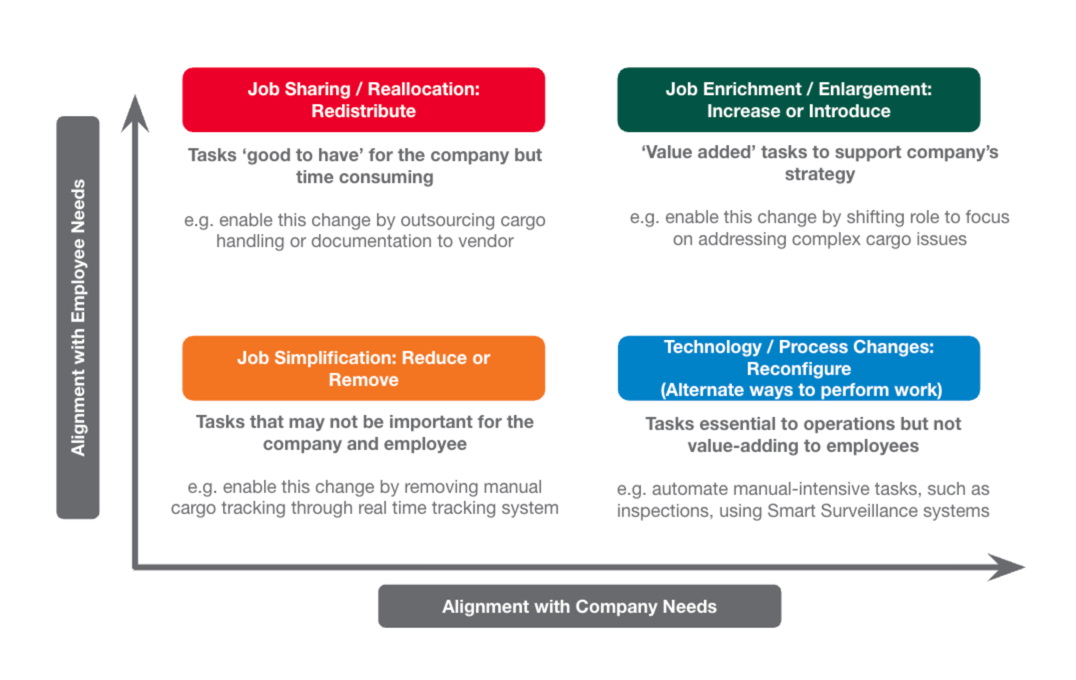
Executing the Step 2.2: Job Redesign Opportunity Matrix

Use this matrix during stakeholder discussions to identify redesign opportunity based on 2 factors:

  • Alignment with Company Needs: Assess if tasks support or contribute to overall company strategy
  • Alignment with Employee Needs: Assess how tasks impact employee motivation and commitment
Job Redesign Opportunity Matrix

For more information

Refer to the Future Jobs and Skills Dashboard to explore different skills requirements, descriptions and applications across key aviation job families. Leverage on the Job Redesign Evaluation tool to embark on job analysis based on 8 pre-defined job aspects to identify high-impact Job Redesign opportunities.

V
Step 3 Cost-Benefit Analysis (Time & Effort) Involve Relevant Stakeholders

Validate & Prioritise

Evaluate identified Job Redesign opportunities to prioritise, considering the potential benefit and complexity to support company goals.

Key Activities

Identify Redesign Opportunities

Identify potential Job Redesign opportunities to be considered, as identified in Step 2.

Utilise Impact Effort Matrix

Use the Impact-Effort Matrix to identify high-impact JR opportunities.

Engage Stakeholders

Discuss with stakeholders to align priorities in immediate or long term.

Generate Business Case

Finalise solution to be implemented and generate business case for leadership approval.

Tools and Templates

Who is Involved?

Head of Department

Endorse outcome of prioritisation plan

Line Manager

Provide inputs on task impact and complexity in alignment with company goals

HR Manager

Using the supporting templates in this slide, engage stakeholders to identify and prioritise Job Redesign opportunities

Job Holder

Provide practical insights on task execution and effort

For more information

Explore the playbook’s recommended metrics library for sector-relevant metrics that you can adopt for your company when building a business case and leverage the Job Redesign Evaluation Tool to facilitate execution of this step.

A
Step 4 Input Goals (Metrics)

Action Planning

This step focuses on creating a clear action plan that guides change systematically and supports smooth implementation.

Tools and Templates

Essential Components for Effective Action Planning
Component What It Means What to Plan For Negative Outcome if Missing What You Will See on the Ground
Objectives A clear picture of why Job Redesign is happening and the future state it will create. Articulate the business case, link redesign to company strategy, and communicate the ‘why’ to all affected employees. Confusion Teams cannot connect daily tasks to the bigger purpose; conflicting priorities and rework.
Skills The capabilities employees need to perform redesigned roles confidently. Identify skill gaps, plan reskilling/upskilling pathways, and tap relevant training providers and SkillsFuture support. Anxiety Employees feel unprepared for new tools or responsibilities; performance dips and disengagement rise.
Incentives Recognition and rewards that motivate employees to embrace new ways of working. Refresh KPIs, recognition schemes and career progression so they reinforce the redesigned roles. Resistance Staff revert to old behaviours; little uptake of new processes despite training.
Resources The tools, technology, time and budget required to execute the change. Secure funding (e.g. via government schemes), allocate technology and equipment, and protect employee time for transition. Frustration Initiatives stall mid-way due to missing tools, time or budget; trust in leadership erodes.
Action Steps A sequenced plan that breaks implementation into manageable activities with clear owners. Assign accountable owners, define dependencies, milestones and success metrics for each workstream. False Starts Pilots launch and fizzle; no clear ownership or sequencing, leading to repeated relaunches.
Timeline for Success A realistic schedule that paces change so it is sustainable. Set phased rollouts, review checkpoints and quick wins to maintain momentum and confidence. Burnout / Drift Either rushed rollouts overwhelm teams, or open-ended timelines cause loss of momentum.
M
Step 5 Pilot Phased Batches Monitor

Mobilise

This step focuses on moving from planning to action with clear structures for implementation, communication and risk mitigation — ensuring aviation teams stay aligned and confident throughout change.

Tools and Templates

Is Your Company Ready to Implement Job Redesign?

A Company is ready to implement JR when there is a…

  • Clear objectives and case for change
  • Strong support from leadership
  • Strong support system for employees (Relevant training, allowances etc.)
  • Measurement framework for success
  • Established action plan

Consider reskilling/ upskilling your talents or enabling your HR in change management via trainings here

P
Step 6 Monitor Success Review Refine

Post-Implementation Review

This step focuses on measuring, reviewing and refining the impact of Job Redesign initiatives to ensure outcomes are achieved and improvements are sustained.

Key Aspects to Address

Monitor

How to measure success and effectiveness?

Evaluate, Review and Refine

Is the Job Redesign initiative achieving desired outcomes?

Tools and Templates

Success Factors for Implementation

  • Define outcomes metrics upfront: from an employer and employee perspective
  • Translate metrics into decisions on whether to scale, adapt or pause further roll out
  • Document baseline before implementation to enable comparison
  • Plan to scale by ensuring support systems, such as training, can handle wider rollout
  • Ensure frontline feedback loop
  • Close any learning gaps

For more information

Explore the playbook’s recommended metrics library for sector-relevant metrics that you can adopt for your company when reviewing success of Job Redesign initiatives and leverage the Job Redesign Evaluation Tool to facilitate the review level of this step.

Illustration: Application Of Job Redesign For A Cargo Handling Officer

Job Redesign (JR) involves restructuring work through task reallocation and process optimisation to support business and/or workforce transformation.

Current StateRedefining Tasks Through Various Job Redesign TechniquesRedesigned State
Cargo Handling Officer

Manually preparing Waybills (AWBs) and cargo manifests, including printing, stamping, filing and handing over documentation

Job Simplification: Streamlined work by removing repetitive or manual tasks

Job Sharing: Reallocated workload or tasks across employees

Job Enlargement: Broadened scope with additional tasks at a similar level

Job Enrichment: Enriched roles through added responsibility or skill growth

Elimination of manual preparation of AWBs and shift to e-AWB system

Engagement of part time officers and having them share shift schedules

Introduction of higher value-added responsibilities, including remote monitoring of systems, analytical reporting

Shift from passive task execution to active task monitoring using a digital task management system